Evaluating Magose: When a Bold Sans-Serif Font is the Right Choice for Your Project
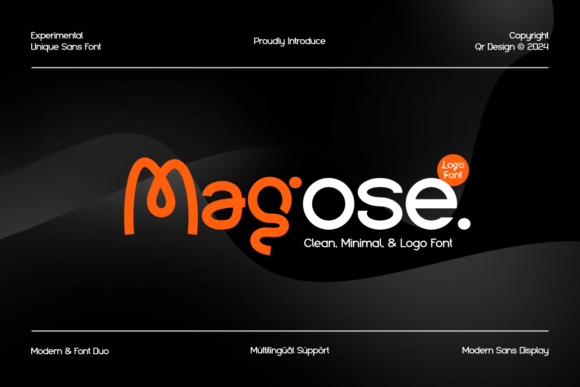
Selecting a typeface is rarely just about aesthetics; it is a strategic decision that influences how a message is perceived and retained. In the realm of digital and print design, the sans-serif category is vast, offering everything from neutral workhorses to highly expressive display faces. Among these, Magose occupies a specific niche as a cool, bold sans-serif font designed explicitly to make a strong visual impact. It is not intended to blend into the background of a paragraph of body text. Instead, its robust letterforms and sharp edges are engineered to exude confidence, making it a contender for powerful headlines, branding projects, and promotional materials that demand immediate attention.
For designers and brand managers evaluating their typography options, understanding the specific personality of Magose is the first step. Unlike geometric sans-serifs that prioritize mathematical perfection or humanist sans-serifs that mimic calligraphic strokes, Magose leans into a modern, industrial aesthetic. The "cool" factor comes from its clean, sharp geometry and a certain assertiveness in its structure. This is a typeface that doesn't whisper; it speaks with clarity and authority. However, this strength is also its primary constraint. The very features that make it impactful in a logo or a hero banner can make it exhausting to read in long-form content. Therefore, evaluating Magose is about understanding this trade-off: you are choosing visual punch over subtle versatility.
Analyzing the Design DNA: What Makes Magose Distinct
To understand where Magose fits, it helps to dissect its design characteristics. The "bold" descriptor is central to its identity. This isn't a font family where the bold weight is an afterthought; it is the core offering. The letterforms are built with substantial strokes, giving them a physical presence on the page or screen. The "sharp edges" refer to the lack of softening or rounding at the terminals and corners. Where some contemporary sans-serifs use subtle curves to appear more friendly or approachable, Magose maintains crisp, decisive angles. This contributes to a feeling of precision and forward momentum.
This design DNA points toward specific use cases. Consider a technology startup launching a new app. A headline set in Magose can communicate innovation and strength without needing excessive styling. For a music festival poster, its boldness ensures the event name cuts through visual noise. In branding, particularly for industries like automotive, sports, or finance, Magose can serve as a primary logotype font, conveying stability and leadership. The key is that its distinctiveness is its value proposition. When you use Magose, you are making a deliberate stylistic statement that aligns with themes of power, modernity, and confidence.
Comparative Context: Magose vs. Other Sans-Serif Styles
No font exists in a vacuum. When evaluating Magose, it is useful to compare it to broader categories of sans-serif typefaces to understand its relative strengths and weaknesses.
Magose vs. Neutral Sans-Serifs
Neutral sans-serifs, often described as "workhorses," are designed for maximum readability and minimal stylistic interference. They are the default choice for body text, user interfaces, and situations where the content, not the font, should be the focus. Compared to these, Magose is far more expressive. Choosing Magose over a neutral option is a conscious decision to inject personality and hierarchy. The trade-off is in flexibility. A neutral font can be used for a headline, a subheading, and a paragraph without issue. Magose is best reserved for the top of the hierarchy. Using it for body copy would likely create visual fatigue for the reader.
Magose vs. Geometric and Humanist Sans-Serifs
Geometric sans-serifs are built on circles and squares, often appearing clean, modern, and sometimes a bit cold. Humanist sans-serifs incorporate organic, calligraphic influences, resulting in a warmer, more approachable feel. Magose shares the geometric family's love for clean shapes but amplifies the boldness and sharpness to a greater degree. It lacks the subtle warmth of a humanist design but also avoids the potential blandness of some minimal geometric fonts. It sits in a more assertive, graphic-design-oriented space. If a project requires a font that feels both structured and full of character for display purposes, Magose presents a compelling case.
Strengths, Tradeoffs, and Best-Fit Scenarios
A practical evaluation requires weighing the pros and cons against the project's goals.
- Strengths: The primary strength is its immediate visual impact. It commands attention in crowded visual environments. Its bold weight provides excellent contrast when paired with lighter, more neutral fonts. It excels in creating a strong brand identity, especially for entities that want to project strength and modernity. It is also highly effective for short, punchy text like taglines, calls-to-action, and single-word statements.
- Tradeoffs: The main tradeoff is limited versatility. It is not a one-size-fits-all solution. Its strong personality can clash with other design elements if not used carefully. It may also be less suitable for projects targeting audiences that prefer softer, more traditional, or highly formal aesthetics. Readability at small sizes or in long paragraphs is not its intended function.
- Best-Fit Situations: Magose is often the right choice for:
- Hero Sections and Headers: The primary headline on a website's landing page or a poster's main title.
- Branding and Logos: Creating a distinctive, memorable logotype for brands in dynamic industries.
- Promotional Materials: Event flyers, social media graphics, and banner ads where grabbing attention quickly is critical.
- Editorial Design: Pull quotes, magazine covers, or chapter titles where a dramatic contrast is desired.
Decision Factors: Is Magose the Right Choice for You?
Moving from general analysis to your specific project involves asking a few key questions. First, what is the primary goal of your typography? If the goal is to establish a strong, confident tone at the highest level of your visual hierarchy, Magose is worth serious consideration. If the goal is to provide comfortable, extended reading, you need a different tool.
Second, consider your audience and context. A bold, sharp font might resonate perfectly with a young, urban audience for a streetwear brand but could feel out of place for a law firm's website or a children's educational book. The context of the message matters as much as the message itself.
Third, evaluate your typographic system. A strong font like Magose works best as part of a pairing. It typically needs a companion—a highly legible, neutral sans-serif or a classic serif—to handle the bulk of the text content. The success of using Magose often depends on the quality of this supporting cast. Does your project allow for such a system, or are you limited to a single font family?
Finally, consider the alternatives within the same bold, impactful category. While Magose has its unique sharpness, other bold display sans-serifs exist. Exploring them can help you pinpoint exactly what you need: perhaps slightly rounder terminals for a friendlier feel, or even more extreme contrast for a purely artistic statement. The goal is to find the font whose specific personality aligns most closely with your project's voice.
In conclusion, Magose is a specialized tool designed for a specific job: creating powerful, attention-grabbing visual statements. Its value lies in its distinct character and its ability to inject confidence and modernity into headlines and branding. It is not a universal solution, and its effectiveness is contingent on thoughtful implementation and appropriate pairing. By evaluating your project's needs for impact, your audience's expectations, and the structure of your typographic hierarchy, you can determine if the bold, assertive voice of Magose is the right one to amplify your message. For projects that demand a strong visual anchor, it presents a compelling option worthy of evaluation alongside other display-oriented typefaces.