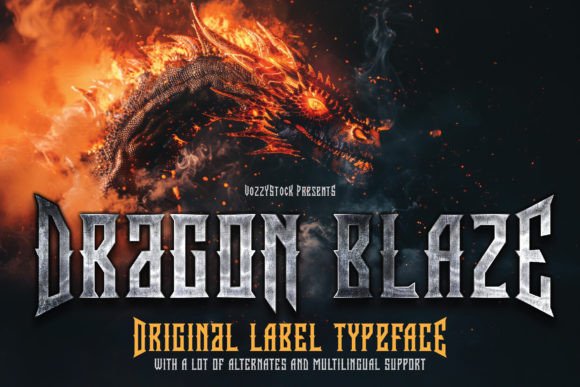
Unleashing Ancient Legends: The Comprehensive Guide to the Dragon Blaze Typography System
In the competitive landscape of digital design, typography is more than just a method of communication; it is the voice of the brand. When a project demands a tone that resonates with power, history, and fantasy, standard sans-serif fonts often fall short. This is where specialized display typefaces come into play, specifically those designed to evoke specific emotional responses. Among the elite tier of fantasy-inspired typography, the Dragon Blaze font system stands out as a formidable tool for creators. It is not merely a set of characters but a comprehensive design ecosystem that breathes the spirit of ancient legends onto modern screens.
This article explores the technical architecture, creative versatility, and practical applications of the Dragon Blaze typeface, offering professionals and hobbyists alike a deep dive into how this asset can transform visual storytelling.
The Anatomy of Dragon Blaze: More Than Just Glyphs
To understand the value of a display font, one must look beyond the aesthetic of the primary alphabet. The true measure of a typeface's utility lies in its glyph count and the variety of its alternative forms. Dragon Blaze distinguishes itself through an extensive library of over 600 glyphs. This high glyph count is not arbitrary; it represents a deliberate effort to provide designers with a robust toolkit for customization.
The Power of Alternative Forms
The defining characteristic of Dragon Blaze is its utilization of alternative letterforms to create visual hierarchy and emphasis. In standard typography, emphasis is usually achieved through bolding or italicizing. However, in the realm of fantasy and gaming aesthetics, these standard treatments can feel flat.
Dragon Blaze addresses this by offering unique alternative forms specifically for uppercase letters. These variations are designed to be deployed at the beginning and end of words. This technique allows the designer to highlight the significance and grandeur of a title without disrupting the legibility of the core text. For example, when creating a logo or a banner, the initial and terminal letters often bear the heaviest visual weight. By utilizing the stylistic alternates provided by Dragon Blaze, a creator can frame a word with ornate flourishes that suggest royalty or ancient lineage.
Furthermore, the lowercase letters offer five distinct alternative variations per character. This level of depth is rare in display fonts and unlocks endless opportunities for creativity. It prevents the "repetitive pattern" look often associated with digital fonts, allowing for a more organic, hand-crafted appearance that mimics the irregularity of historical manuscripts or hand-painted signage.
Visual Context: The Role of High-Resolution Assets
A font rarely exists in a vacuum. To fully appreciate the capabilities of a typeface like Dragon Blaze, it must be viewed within its intended context. Typography designed for "epic" themes requires an environment that matches its intensity.
When integrating Dragon Blaze into a project, the background imagery plays a crucial role in grounding the text. The font is designed to command attention, but it requires a stage to perform upon. This is why high-resolution visual assets are essential to the workflow. For instance, when designing a poster or a banner, the background image must support the sharp, swift edges of the font.
In professional design workflows, the use of high-resolution PNG files—specifically those exceeding 4000 pixels on the largest dimension—is standard practice for assets that accompany display fonts like Dragon Blaze. These large-format images ensure that the texture and detail of the background do not compete with the crispness of the typography. Whether the background depicts a misty landscape, a medieval fortress, or abstract magical energy, the clarity of the image must match the precision of the font. The synergy between a high-fidelity font and a high-resolution background creates a cohesive visual narrative that is essential for impactful marketing materials and game art.
Strategic Applications: Where Dragon Blaze Excels
The utility of Dragon Blaze extends across various sectors of the creative industry. While it is heavily associated with computer games, its application is broader, touching on any project that requires a sense of weight, history, or drama.
1. Gaming and Entertainment Media
The primary domain for Dragon Blaze is the gaming industry. The font is optimized for the "Sword and Sorcery" and "Dark Fantasy" genres. Its design language—swift and mighty—aligns perfectly with the aesthetics of role-playing games (RPGs) and massively multiplayer online games (MMOs).
- User Interface (UI): While display fonts are generally reserved for headers, the legibility of Dragon Blaze allows for limited use in UI elements such as quest titles, location names, or inventory headers.
- Key Art: For game covers or promotional posters, the font provides the necessary "punch" to grab a viewer's attention instantly.
2. Cinematic Posters and Book Covers
Beyond gaming, the font is a powerful asset for the publishing and film industries. A book cover for a fantasy novel or a movie poster for an action-adventure film requires typography that instantly communicates the genre. Dragon Blaze serves this purpose effectively, reducing the need for complex illustrations to convey the theme. The font itself carries the narrative weight of "ancient legends."
3. Branding for Thematic Events
Event organizers for themed experiences, such as escape rooms, LARP (Live Action Role-Playing) events, or themed restaurants, can utilize Dragon Blaze to create a cohesive atmosphere. The font can be applied to tickets, signage, and merchandise to immerse participants in the experience from the moment they receive an invitation.
Technical Considerations and Best Practices
While Dragon Blaze offers immense creative freedom, its effective use requires an understanding of typographic principles. Because it is a display font with high ornamental value, certain considerations must be taken into account to maintain readability and professionalism.
Spacing and Kerning
Fonts with complex swashes and alternative forms often require manual kerning adjustments. The ornate flourishes on the uppercase letters in Dragon Blaze can sometimes encroach on the space of adjacent characters. Designers must be prepared to manually adjust the tracking and kerning to ensure that the letters breathe properly, maintaining a balance between the grandeur of the style and the legibility of the word.
Color and Contrast
Given the "energy and passion" infused into each letter, Dragon Blaze performs best in high-contrast environments. Placing the font on a dark, textured background often yields the best results, allowing the edges of the letters to stand out sharply. However, care must be taken when using light-colored text on dark backgrounds to ensure that the fine details of the lowercase alternates remain visible.
Pairing with Body Text
It is a rare scenario where Dragon Blaze should be used for body copy. Its intricate design is intended for short bursts of text—headlines, logos, and titles. For any accompanying body text, designers should pair it with a clean, highly legible sans-serif or serif font. This contrast creates a visual hierarchy that guides the reader's eye, using Dragon Blaze for the "hook" and a simpler font for the information.
The Creative Workflow: Integrating Dragon Blaze
For creators looking to integrate this asset into their workflow, the process involves more than just installation. It requires a strategic approach to design.
- Conceptualization: Identify the specific "mood" of the project. Is it dark and gritty, or bright and heroic? Dragon Blaze offers versatility, but the specific alternative forms chosen should match the tone.
- Asset Preparation: As noted, high-resolution backgrounds are essential. Before finalizing the typography, ensure the background layer is locked and scaled appropriately (e.g., 4000px+ resolution).
- Typography Selection: Utilize the glyph panel in your design software to explore the 600+ glyphs available. Do not settle for the default "A" or "B"; explore the variations to find the shape that best fits the composition.
- Final Polish: Apply effects such as beveling, embossing, or texture overlays to the text. Because the font has strong structural lines, it responds well to 3D effects that enhance its "swift and mighty" character.
Conclusion: The Arsenal of Creativity
The Dragon Blaze font represents a shift in how designers approach thematic typography. It moves beyond static character sets to offer a dynamic system of creative possibilities. By leveraging over 600 glyphs and a sophisticated system of alternative forms, it empowers creators to bring their boldest ideas to life.
Whether used for a sprawling fantasy map, a striking logo, or an epic banner for a computer game, Dragon Blaze